
Introduction
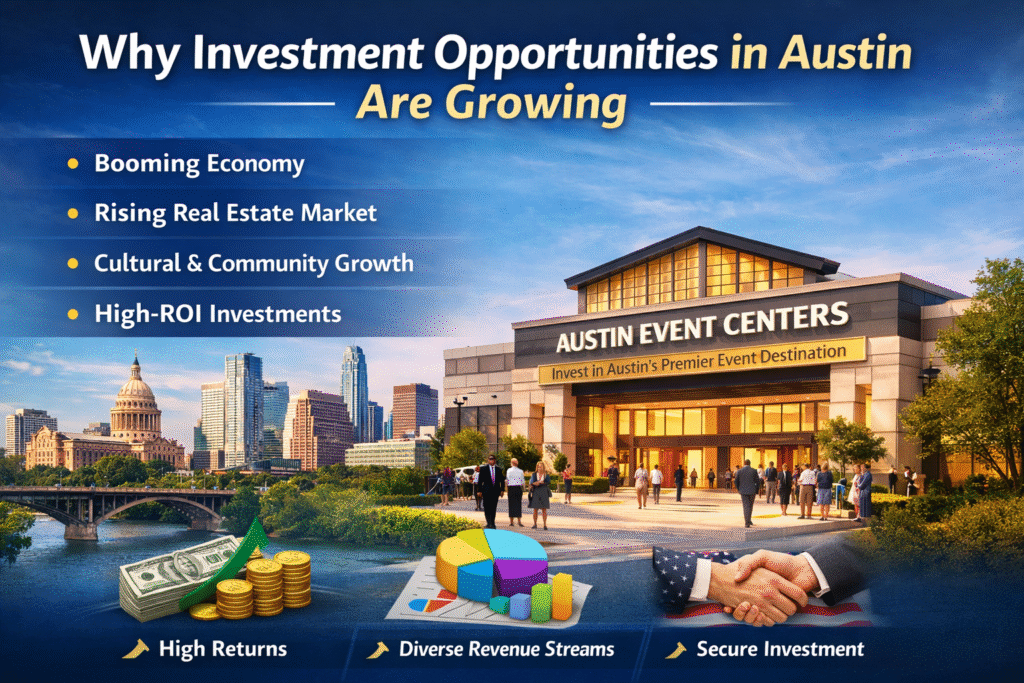
The city of Austin, Texas has emerged as one of the most dynamic investment landscapes in the United States. With its thriving economy, strong population growth, and vibrant cultural scene, investors are increasingly turning their attention to this economic powerhouse. Beyond broad market trends, projects like Austin Event Centers are opening new doors for investors who want to be part of Austin’s long-term growth story.
Austin’s Rapid Economic Growth
Austin’s economy continues to outperform many U.S. markets, supported by innovation, workforce expansion, and strong business migration.
Major technology companies have expanded their presence in Austin, creating thousands of jobs and fueling demand for commercial and lifestyle infrastructure. The city’s consistent economic expansion and growing population are driving higher demand for real estate, professional venues, and experience-based businesses. These factors make Austin investment opportunities increasingly attractive for both short-term and long-term investors.
Real Estate as a Core Growth Driver
Real estate remains one of the strongest pillars of investment in Austin. Both residential and commercial properties have demonstrated steady appreciation, supported by rising population and business activity.
Commercial venues in particular are gaining attention. Event spaces, cultural centers, and mixed-use properties provide not only asset appreciation but also active income generation. This makes them appealing to investors seeking predictable cash flow along with long-term valuation growth.
The Rise of Experience-Driven Investments
Modern investors are focusing more on businesses that combine financial performance with community relevance. Event destinations are becoming high-value assets because they support multiple income streams while meeting growing social and cultural needs.
Projects like Austin Event Centers are designed around diversified revenue models, including event rentals, catering services, cultural programs, festivals, cafeteria operations, and in-house services. This structure strengthens financial stability and reduces dependency on a single source of income.
Why Austin Event Centers Fits the Growth Curve
Austin Event Centers is strategically positioned in the Georgetown area of the Austin metro region, a location experiencing strong development momentum.
The project’s phased expansion plan, beginning with a flagship center and followed by two additional venues, provides built-in scalability. Financial projections highlight strong revenue potential supported by diversified services and rising regional demand. The concept also aligns closely with Austin’s growing cultural engagement and community-focused development trends.
Broader Investment Trends in Austin
Austin’s investment ecosystem continues to expand across multiple sectors. Technology, healthcare, infrastructure, education, hospitality, and commercial real estate are all contributing to the city’s rising investment profile.
This diversified environment makes Austin resilient during economic cycles and attractive to investors seeking stable markets with high growth potential.
How Investors Can Participate
Investors can explore multiple paths into the Austin market, including commercial real estate, venture-backed enterprises, and revenue-generating business ventures.
Austin Event Centers offers a structured investment opportunity with clear development phases, projected financial growth, and defined participation models, making it suitable for investors looking for long-term involvement in a scalable venture.
Frequently Asked Questions (FAQs)
What makes Austin investment opportunities so attractive right now?
Austin investment opportunities are growing rapidly because of strong economic expansion, corporate relocations, population growth, and rising commercial demand. Austin’s business-friendly environment, innovation ecosystem, and expanding infrastructure continue to support both short-term returns and long-term investment growth.
Is investing in Austin Texas a good long-term strategy?
Yes. Investing in Austin Texas is widely considered a strong long-term strategy due to consistent job creation, real estate appreciation, and increasing demand for commercial and cultural spaces. These factors support long-term capital appreciation and stable revenue generation.
How does Austin economic growth impact investors?
Austin economic growth directly benefits investors by increasing demand for real estate, professional venues, hospitality services, and experience-driven businesses. As the population and corporate presence expand, investment assets gain higher utilization, stronger cash flow potential, and long-term valuation support.
What types of high-growth investments in Texas are emerging in Austin?
Some of the most notable high-growth investments in Texas are emerging in Austin’s commercial and experience-based sectors. These include event centers, mixed-use commercial properties, cultural destinations, hospitality-backed ventures, and multi-purpose business platforms that generate revenue from diversified sources.
What are the most promising business investment opportunities in Austin?
The most promising business investment opportunities in Austin include commercial venue businesses, event-driven enterprises, hospitality-backed ventures, and community-centered commercial developments. These opportunities combine real estate fundamentals with operating revenue, making them attractive to long-term investors.
Why are event centers becoming popular investment assets in Austin?
Event centers are becoming popular because they operate as revenue platforms rather than single-use properties. They generate income from event rentals, catering, corporate functions, cultural programs, and partnerships. This diversified structure makes them appealing within the broader Austin investment opportunities landscape.
Final Thoughts
Investment opportunities in Austin are growing because the city successfully combines economic strength, population growth, and cultural expansion. Ventures like Austin Event Centers reflect this evolution, offering investors access to both real estate-backed security and experience-driven revenue models.
For investors looking to align capital with growth, Austin represents not just a market, but a movement.

